A closer look at life. Discover the science behind the motion

Donghan Lee’s Group · Biomolecular NMR

Life, in motion.

Revealing the hidden dynamics of proteins.
Opening new possibilities for discovery.

BEYOND THE STRUCTURE
A world of motion.
FROM ATOMS TO FUNCTION
A deeper understanding.
Ubiquitin ERNST ensemble · PDB 2KOX ↗ · motion interpolated between ensemble members

Exploring molecular life.
Connecting disciplines.

BioNMR LabDonghan Lee’s
Research Group
KBSIKorea Basic
Science Institute
USTUniversity of
Science & Technology

Structure. Dynamics. Function.

Our research

Beyond a static picture.

Proteins move. They change shape, recognize partners, and carry signals. We study the motions that make biology work.

01 / METHODS

Making the
invisible visible.

Advanced NMR methods and deep learning bring transient protein states into focus.

Explore NMR & AI

We develop CPMG and R₁ρ relaxation-dispersion methods to probe microsecond-to-millisecond dynamics, including the supra-τc window. Deep learning helps make the analysis of time-domain NMR signals more robust.

Read our deep-learning NMR study ↗
02 / DYNAMICS

Small motions.
Essential functions.

From disordered proteins to allostery, we connect molecular motion with biological function.

Explore protein dynamics

We investigate p53 and 4EBP1, the collective motions of ubiquitin, and allosteric communication in proteins such as guanylate kinase. Our goal is to understand how conformational ensembles shape molecular recognition.

Read our allostery study ↗
03 / DISCOVERY

Understanding.
With impact.

NMR-guided screening and structural insights help us investigate therapeutic targets.

Explore drug discovery

Our work includes BLVRB inhibitors, drug repositioning for PTP4A3 (PRL-3), and the p53–MdmX/Mdm2 interaction. We connect computational screening with experimental investigation.

Read our BLVRB study ↗

Biomolecular NMR   /   Protein dynamics   /   Artificial intelligence   /   Drug discovery

Software & methods

Small tools.
Big discoveries.

Meet TRACT. A practical NMR method for estimating how fast proteins tumble in solution.

Explore TRACT
TRACT¹⁵N–¹H relaxation
1.00.500Relaxation delayNormalized intensity
α spin stateβ spin state

Schematic illustration · not experimental data

Selected work

Questions into discoveries.

Browse all publications

Meet the principal investigator

Donghan Lee.

A curiosity for how life works.

Bringing together NMR spectroscopy, protein science, and computation to understand biomolecules in motion.

Korea Basic Science Institute
University of Science & Technology

Meet Donghan & the group
Donghan Lee smiling at a scientific conference.
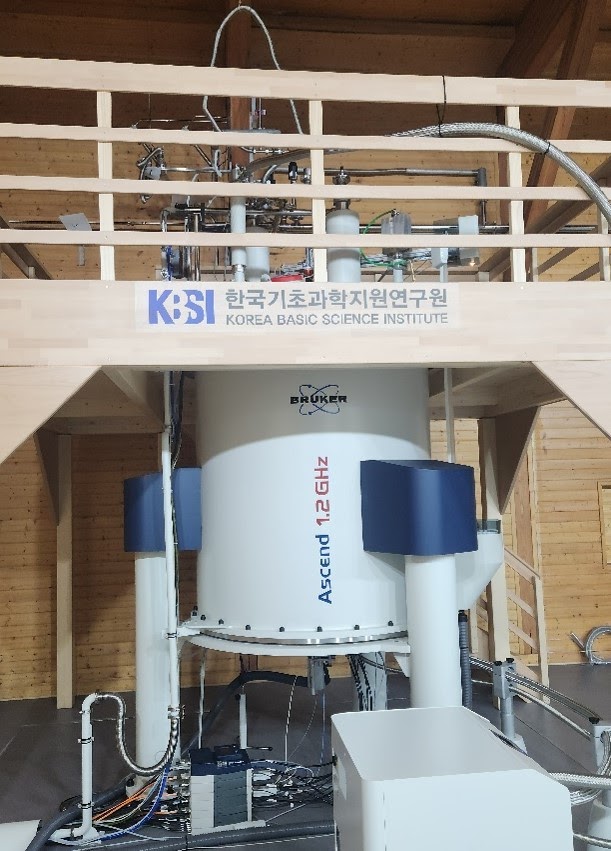
Bruker Ascend 1.2 GHz NMR spectrometer at the Korea Basic Science Institute.

Our resources

Built to look closer.

  • NMR spectroscopyBruker instruments from 400 MHz to 1.2 GHz: 400, 600, 700, 800, 900 MHz, and 1.2 GHz.
  • Protein scienceE. coli and mammalian expression. FPLC and HPLC purification.
  • Biophysical assaysITC, SPR, BLI, circular dichroism (CD), dynamic light scattering (DLS), and small-angle X-ray scattering (SAXS).

Let’s explore together

Good science starts
with a conversation.

Interested in our research, tools, or a collaboration?

Get in touch